Follow me on Pinterest

Follow Me on Pinterest
Showing posts with label Portland neighborhoods. Show all posts

Friday, April 26, 2013

Rhododendrons Light Up Portland Gardens

Vivid rhodi bush lights up a 4-square off SE Belmont

Those vivid rhododendrons are in bloom again. 
Rhodies come in: orchid pink, bright magenta, scarlet, pale pink, cream, and a rare apricot yellow, an unusual peach-orange, and their bushes are packed with tightly spaced, scentless blossoms. 

These bushes will be lighting up Portland neighborhoods for about the next few weeks or so. Their display is short lived, but breathtaking.

To anyone outside of Portland, the density and hue of their blooms is hallucinogenically thrilling. Like the purple jacarandas of Australia, or the lightning yellow forsythia, these blossoms crowd out all the green leaves, and all you are left seeing is a blaze of enchanting color.

To Portlanders, they are common enough as to be ripped out if inconveniently located, however, these gorgeous bushes signal that spring is here, like no other plant does! 

Thursday, April 25, 2013

Portland Monthly Defines "Microhood"

Portland Monthly Magazine expands the definition of Portland's "20 minute neighborhoods" to include smaller areas united by a specific theme, calling them Portland's Hottest Microhoods. 

A microhood is an area of town, off the main beaten path of our well-known and beloved walkable neighborhoods, but still with a characteristic theme in place, which creates a hub of offbeat interest for the locals. And: generates interest in little-watched areas of the city which may be "up and coming."

Also:

"Prices in Portland are up 6 percent over last year, home sales are up 20 percent, and time on the market is down to 64 days."

(Prices are up 9% all in all, since the lowest days of the crash)


Saturday, April 20, 2013

Portland Neighborhoods: Brooklyn, Sellwood & Moreland

Running from Division southward to Milwaukie, bounded on the west by the river and on the east by 82nd Avenue, Sellwood and East and West Moreland and Brooklyn contain Reed College and a few very pleasant neighborhood hubs.

 Sellwood 100 years ago
The Brooklyn neighborhood's mostly 1800's/early 1900's homes are interspersed with industrial and commercial buildings clustered along Milwaukie Street, south of Powell. The vintage-kitsch Aladdin Theatre hosts legendary music acts, and is the visual cue that you are entering Brooklyn.

Driving further south, Sellwood homes range from the late 1800s to the 1950s, with build-ins and apartment buildings from the 1960s onwards, built on the grid. At it's birth in 1883, Sellwood developers hosted a free Willamette River ferry to shuttle potential home buyers from Portland to Umatilla (pron. you-ma-tilla) street. The neighborhoods running off Milwaukie Street, the main commercial band that runs through Sellwood, tend to have slightly larger lots, with more spacious mid-century developments. Parking can be tight in this area near the thoroughfares, but streets are well planted with trees and landscaping, and have a classically American, beautiful neighborhood look to them.
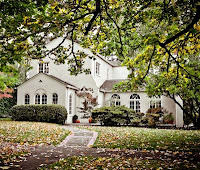
1930's Spanish Colonial home in Eastmoreland

The Moreland neighborhood homes near Reed College have larger lots, and more spacious, stately homes: mostly Bungalows, Tudors, Cape Cods/Colonials up to WWII, and ranches from mid-century, with more attention and care paid to yards.

Nearby Reed College can be said to be the Bennington of the West Coast, with a progressive tradition and an inventive course structure. Academics are at the heart of this college, which has no sports teams or fraternities which so often impact the campus environs and nearby homeowners. Of course, local renters are college students and employees.
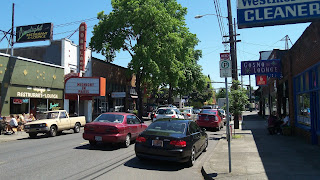
Moreland with it's Art Deco movie theatre
Westmoreland tends to be slightly more modest and commercially located, while Eastmoreland, as per it's proximity to the Waverly Country Club, has sweeping and curving streets and large, immaculately landscaped lots. Eastmoreland is bounded by Woodstock Blvd, Johnson Creek Road, McLoughlin Blvd, and Steele St.

Since it's 'rediscovery' in the late 1990s, Sellwood/Westmoreland has a slightly more upscale and family-centered feel, clustered around independently and locally owned antique malls and shops, Mediterranean/Asian restaurants alongside upscale national chains one sees in trendy University towns, which are clustered along Milwaukie Street.

River front park in Sellwood
Sellwood perches a top a bluff over the Willamette River, with some of the nicest views in the city, seen from some of the least-likely to be sold houses in the area, on the meandering street that goes past Oaks Park, a former amusement  park. Farther down, the waterfront River Park is popular with walkers and dogs, and is a verdant place to get some fresh air near the river.
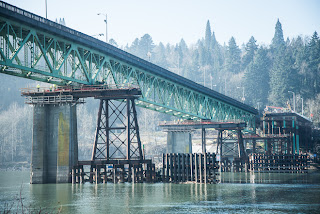
Sellwood Bridge undergoing transformation


Currently, the Brooklyn/Sellwood area is going through some growing pains, with elaborate road construction in the industrial areas, as well as the replacement of the Sellwood Bridge (which makes Beaverton and Lake Oswego easily accessible over the river). Local opinions can run high over taxes and traffic inconveniences, yet over the long term the changes appear to be for the good of these Portland neighborhoods.


Friday, February 1, 2013

Portland Southeast Neighborhoods: Montavilla & Tabor

Mt. Tabor's volcano top features a green park

The area of Mt. Tabor encompasses the streets on or near Mt. Tabor itself, under their various names: Tabor, Taborside, Tabor West, North, or East. Montavilla is roughly bordered by Halsey in the North, a few blocks east of Hwy 205 in the East, Division in the South, and about 60th Avenue or so to the West.

Stark St and 80th looking NW in 1939


An inactive volcano, Mt. Tabor formed a minor physical barrier to the original developers of the late 1800s east side Portland, and Tabor hill was used mostly for winter tobogganing by the neighborhood kids for decades. Now the hill and all it's sides are built in, and chunks of the ancient volcano's dried lava innards end up in local yards.

Homes directly near or on Mt. Tabor tend to be more upscale than those found in Montavilla, and folks placed along the peripheries will claim to be in "Tabor," (Tabor Park, Taborside, East Tabor) regardless. The top of Mt. Tabor is set aside for a walkable park commemorating the volcano, and the homes built onto it's top and sides have some of the finest views in all of southeast side Portland. Some of these homes are from late 19th Century, while most were built in the mid-20th century and have a coastal/Hollywood feeling, making the most of the views from their extensive patios.

Stark Street in Montavilla feels like a 
vibrant small town mainstreet

Montavilla's homes are more diverse in size, condition, and upkeep than those of Tabor, yet Montavilla's great advantage is having a westward running "main street" (Stark Street), which lends the area the feeling of a small midwestern town. Right now it's amenities are all independently owned and designed businesses, reflecting the undiscovered and unexploited nature of Montavilla: the Country Cat, Ya Hala and Flying Pie Pizza restaurants provide the food, while the rest of Stark street hosts eclectic shops, antique stores, bars and coffeehouses, 
wellness and service businesses, among others, and the Academy Theatre.

Montavilla bungalow

Montavilla was once it's own separate town, and the most eastern one nearest to Portland. Though Portland has grown out way beyond the Highway at 205, Montavilla remains one of the few outer eastern areas with an actual neighborhood heart and a walkable center. 
A classic Montavilla 
house with porch
Homes here are a mixture of the decades of the 20th century, all mostly modest and small in scale: with one and two bedroom working class Edwardians, bungalows, Cape Cods, Tudors and ranch homes.


Retro Academy Theatre 
shows 2nd releases
Empty lots or scrapable houses continue to be filled in with new building, and large lots are often carved into sections, encouraging denser populations so close to Portland's center. Rentals are well represented. Some homes are placed along unimproved roads running east and west, linked to the paved numbered streets. These give the neighborhood an especially country-town-in-the-middle-of-the-city atmosphere, although these dirt streets are currently on track to be paved (without storm drains or sidewalks), under future improvement plans initiated by former Mayor Sam Adams.


The iconoclastic Bipartisan Cafe 
Montavilla also has it's own recreation center and a variety of parks nearby, and runs a warm season Farmer's Market the whole area supports and enjoys. This Portland neighborhood is ideally situated between the funky and eclectic Southeastern inner neighborhoods and the suburban box amenities east of Highway 205: it has the best of both worlds.

Every few years Montavilla is "discovered" as the next hip and walkable neighborhood, but it continues to hold on to it's independent hometown character, which is exactly what it's habitants like about it.

Friday, January 25, 2013

Portland Neighborhoods: Hawthorne / Belmont / Sunnyside

Welcome to my weekly run down of the character of Portland's neighborhoods. Meet me here every Thursday through February to catch the flavor of Portland's inner Southeast. 

Southeast Stark Street, Hawthorne Street, Belmont Street, and Division Streets, from approximately 12th Avenue to about 60th Avenue in southeast Portland, is the range of neighborhood we're talking about today. 

To the south is Division St, and to its north is Stark St, containing Hawthorne and Belmont Streets, and this quad of East/West running streets forms the locus of one of Portland's most eccentric and trend-reflecting areas of town--while still, overall, having a feeling of intimacy and inclusive community. 
Belmont and 50th in the '20s

East of the river began to be settled in the late 19th century with large, impressive farmhouses, and gradually filled in with simple, middle- to working class homes from the '10s through to the '50s, with the last bits of free space taken by mid '60s apartment buildings, all built on a grid street system. 
Apartments on Belmont

By the 1920s and '30s the main arteries of Hawthorne, Belmont and Division were established as the commercial areas, and they still haven't lost their importance in the daily life of these Portland neighborhoods, as they are still where people shop, meet, eat, and get their needs met. 

New construction today tends to be either scraped-off, newly constructed condominiums, or modern design apartment buildings along Belmont and Division. As the city has not been requiring developers include on-site parking lots for all the people living in these structures, streets nearby them are or will certainly be filled in with cars to their very limits. 

Close-in, Southeast Portland neighborhoods are generously landscaped: trees were important in the early days, and they shade nearly every street or yard, even when structures are newer. Some streets are lined with huge trees planted last century, especially those taken up with large Edwardian or Craftsman style homes, while others reflect 1920s developments with cute brick Tudors, while still other streets are an eclectic mixture representing a range of yard-design trends in the 20th century.  
Typical '20s Tudor with few large trees

The bone structure of the areas closest to the business areas is delicate, with narrow streets lined with parked cars. Drivers must be especially mindful of numerous bicyclists in every kind of weather and season. Many houses have their own driveways, yet finding parking can be a challenge here. On the other hand, this area is imminently walkable, with a near European feeling of pedestrian-friendliness.
Sunnyside bungalow in iconoclastic colors

The urban farmer is well established in these neighborhoods: some backyards have chickens, or front yards given to sprawling permaculture, neat rock gardens, or planted-in retaining walls. 

House colors reflect the inner character of their owners: you will find a bright lilac Victorian with prayer flags hanging off the porch and a buddha surrounded by plastic animals as an altar in the front yard, just as you will find a restrained, oyster hued, late 1940s Cape Cod with a stately burgundy door and nickel fittings planted in the center of a neat grass yard. Diversity of expression rules, here. 
Stately Stark St Cape Cod 

Twenty or thirty years ago, Hawthorne street was inhabited by scruffy hipsters. The houses have now gone to working professionals, while the rentals may still be hipster inhabited. The boomtime of the '90s to about 2005 added multi-unit housing to Belmont street, upscale organic grocery retailers, and university-town style chains (Laughing Planet Cafe) or independent coffee/cupcake/ethnic gift/trendy clothing shops, along with national franchises (Ben & Jerry's ice cream, Starbuck's, Zoom Urgent Care) to Hawthorne, replacing some of the independent run businesses, but generally expanding the diversity of commercial amenities, while strengthening the position of independent run businesses.  Alongside big box grocery and drug stores live the regular-joe or distinctive places of character like The Horse Brass Pub, Nick's Coney Island, The Waffle Window, and The Bread and Ink Cafe, as well as shops: Memento, Powell's Home and Garden bookstore, and Presents of Mind. 
Hawthorne's Bagdad Theatre at dusk

McMinamin's neon-lit Bagdad Theatre anchors mid-Hawthorne with its movies, restaurant, bar, and author's nights. The economic base of this area is diverse: from well-to-do Ladd's Addition and Laurelhurst Park surrounds, to the eco-interested families and working partnerships that define the blocks surrounding the Sunnyside Environmental school. Apartments are well dispersed within these neighborhoods, too.

Multnomah County's beloved and well-used Belmont library branch is located between Belmont and Hawthorne on Cesar Chavez Blvd.

Division is well known as a hub of independent restaurants and food carts. Another food pod lives on Belmont at 42nd Avenue, and another at Hawthorne and 20th Ave.  Food cart eating is an essential part of the inner Southeast lifestyle, and has made Portland, Oregon America's preeminent independent food city of the moment: Portlanders eat well, here.
Local Stumptown Coffee on Belmont

This is an area of Portland with a sense of initiative and humor: besides having many of the most unusual and notable restaurants, shops with clever and inventive inventory that showcases local artists and illustrators live here.

What makes this area so desirable is its proximity to a wide range of human expression: everyone is welcome in inner Southeast Portland. You might see a dreadlocked cellist or a bearded man in purple tights making balloon creatures, couples or families shopping, professor-y old friends meeting to talk, or skinny-jeaned hipsters bent over their computers, writing, in coffee shops. It's a wonderful neighborhood to live in.